

Table of Contents
- What Commercial Office Plant Maintenance Services Actually Cover
- What an Office Plant Care Schedule Should Look Like
- Your Office Plant Maintenance Checklist for Between Visits
- What Office Plant Maintenance Cost Really Comes Down To
- Low Maintenance Office Plants That Survive Real Workplaces
- In-House or Outsourced: Choosing Your Maintenance Route
- Frequently Asked Questions
Last Updated: 12 October 2026
What Commercial Office Plant Maintenance Services Actually Cover
Commercial office plant maintenance services are the scheduled care programmes that keep workplace greenery alive, healthy and presentable without anyone on your team lifting a watering can. At Plant Warehouse, we supply plants for offices, hospitality and commercial interiors, and we see the same pattern repeatedly: plants die from neglect, not from bad luck. A proper maintenance service covers watering, feeding, leaf cleaning, pest checks, pruning, rotating plants toward the light, and replacing anything that has given up. HSE guidance on workplace welfare and environment sets the tone for why a cared-for environment matters, and greenery that looks half-dead does the opposite of what you intended. The core of any contract is simple: someone qualified visits on a schedule, does the work, and tells you when something needs replacing.
What an Office Plant Care Schedule Should Look Like
An office plant care schedule is a written plan of what happens to each plant, how often, and who does it. Most commercial contracts run on a weekly or fortnightly visit, with the frequency driven by plant type, light levels and how warm the building runs. A practical schedule looks like this:
- Weekly: watering where needed, removing dead leaves, checking for pests
- Fortnightly: feeding during growing months, rotating plants for even growth
- Monthly: deep-cleaning leaves, checking pots and saucers for water damage
- Quarterly: reviewing which plants are struggling and swapping them out
The mistake we see most often is treating every plant the same. A ZZ Plant in a dim corridor needs far less water than a Boston Fern by a sunny window, and a schedule that ignores that difference will drown one and dry out the other.

Your Office Plant Maintenance Checklist for Between Visits
An office plant maintenance checklist is the short list of tasks your own team can handle between professional visits. You do not need horticultural training to keep things ticking over. Assign one person, give them fifteen minutes a week, and work through this:
- Check the top 2cm of soil in each pot. Water only if it feels dry
- Pick up fallen leaves before they sit on desks or carpet
- Turn plants a quarter turn so they grow evenly
- Look under leaves for sticky residue or small insects
- Move anything sitting in direct midday sun behind a blind
- Note any plant looking yellow, drooping or bare and flag it
A common mistake is overwatering in winter, when plants use far less water and central heating dries the soil surface while the base stays wet.
What Office Plant Maintenance Cost Really Comes Down To
Office plant maintenance cost depends on three things: how many plants you have, how often someone visits, and whether you rent or own the plants. A small office with a handful of plants on a fortnightly visit sits at the bottom of the range. A large reception with statement plants and weekly visits sits at the top.
| Your Setup | Visit Frequency | What Drives the Cost |
|---|---|---|
| Small office, under 10 plants | Fortnightly | Travel time, minimum visit charge |
| Open-plan floor, 10-30 plants | Weekly | Plant count, watering time, replacements |
| Reception and meeting rooms | Weekly | Statement plant care, seasonal swaps |
| Multi-floor or multi-site | Weekly or more | Travel between sites, reporting |
The honest answer is that the cheapest quote is rarely the cheapest contract. Replacement costs for plants that die under poor care usually outweigh what you saved on visits.
Low Maintenance Office Plants That Survive Real Workplaces
Low maintenance office plants are species that tolerate missed waterings, low light and the dry air of a heated building. We choose these for commercial spaces because they fail less often, which keeps replacement costs down. Integrating these resilient specimens into a broader strategy for commercial office cleaning ensures that the workspace remains both tidy and vibrant without requiring constant intervention.
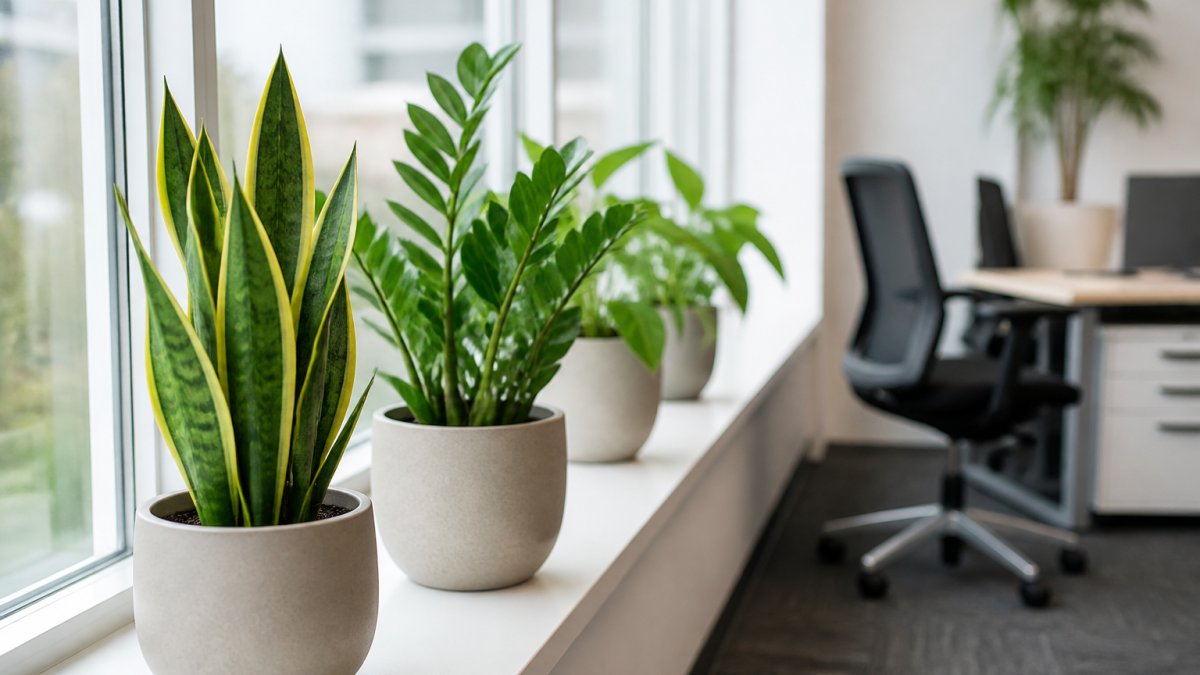
Our picks for offices, all available from our own stock:
- Snake Plant 'Laurentii' (£15.00) - handles low light, bright light and missed waterings without complaint
- ZZ Plant (£20.00) - sculptural and practically indestructible, at home in a dim hallway or a bright room
- Parlour Palm (£8.50) - compact and elegant, a staple of indoor greenery since the Victorian era
- Peace Lily (£90.00) - good in lower light, and it droops when thirsty, which tells you exactly when to water
Plants for Dim Corridors and Windowless Meeting Rooms
Dim corridors and windowless meeting rooms are the hardest spots in any office, and they are where most plant schemes fail. The Snake Plant 'Laurentii' and ZZ Plant are the two we recommend first, because both cope with low light and irregular watering. The Parlour Palm is a good third choice where you want something softer and more compact. What most guides miss is that "low light" does not mean no light. A windowless room with the door open all day still gives a plant more than a sealed storage cupboard, and even tolerant plants need some natural light to hold their shape.

Statement Plants for Reception Areas
Reception areas need scale and presence, and they usually have the best light in the building. The Kentia Palm (£160.00) softens a room with tall, feathered fronds, and it is slow growing and easy going. The Fiddle Leaf Fig (£195.00) is the design classic, clean and sculptural, and it fills an empty corner beautifully once settled. Where ceilings are high, the Bird of Paradise (£50.00) brings real drama with huge banana-like leaves. For something softer, the Areca Palm (£65.00) fans out to soften corners.
In-House or Outsourced: Choosing Your Maintenance Route
Outsourcing suits most offices because plant care is a specialist task that no one on your team owns. In-house works when you have a genuine plant enthusiast on staff and a small, simple collection.
Three questions decide it:
- How many plants? Under ten, in-house is realistic. Over thirty, it becomes a job.
- How visible? Reception and client-facing areas need plants that always look sharp.
- What happens when someone leaves? If care depends on one person, it stops the day they do.
A hybrid route works well: a professional contract for the main scheme, with your team handling the checklist between visits. That keeps costs sensible and plants healthy.
If you are buying plants for an office, our Snake Plant 'Laurentii', ZZ Plant and Parlour Palm are the ones we would start with, and our team can advise on light, room type and care level before you commit.

Office greenery only works if someone is actually looking after it, and that is the part most workplaces get wrong. Plant Warehouse supplies plants for offices, hospitality and commercial interiors, with free delivery on orders over £70 and expert guidance on low-light and low-maintenance varieties. Our team holds an RHS Chelsea Flower Show Gold Medal, and we help businesses choose plants that suit their real light and space. Get started with Plant Warehouse and build a scheme that still looks good in six months.
Frequently Asked Questions
What do commercial office plant maintenance services include?
Most cover watering, feeding, leaf cleaning and dusting, deadheading, pruning, pest and disease checks, rotating plants towards the light, and replacing any plant that fails to thrive. Visits are usually scheduled weekly, fortnightly or monthly depending on the planting scheme. Plant supply, containers, installation and removal at end of contract are often bundled in. Ask for the visit frequency and the replacement policy in writing before you sign.
How often should office plants be professionally maintained?
A fortnightly visit suits most open-plan offices with a mixed planting scheme. Large reception displays and high-light positions such as atriums often need weekly attention, while a scheme built entirely from low maintenance office plants can hold up on a monthly visit. Seasonal shifts matter too: plants need more water in summer and less in winter, so a fixed calendar with no flexibility tends to cause problems.
How much do office plant maintenance services cost?
Pricing is normally quoted per plant, per visit, or as a monthly retainer covering a set number of plants. Cost depends on the number of plants, their size, how often the team visits, and whether the contract includes supply, containers and replacement. A small scheme of a dozen low maintenance plants costs far less than a full atrium installation. Always ask for a written quote that separates plant supply from ongoing maintenance.
Can office plants survive in rooms with little natural light?
Yes, provided you choose the right species. Snake plants, ZZ plants and Parlour Palms all cope with dim conditions and irregular watering, which is why they appear in so many office schemes. The main risk is overwatering rather than low light, so water less often than you think and check the compost before adding more. Rotate plants towards any available light every few weeks to keep growth even.